Fyxer raised a $30M Series B. Its homepage shows the assistant answering a real question.
How London's AI assistant sells to client-facing teams: a command in the headline, sign-up with the account you already use, a chat that cites its sources, and a founding story told as a number.
Published 24 November 2026
- Milestone
- Series B · $30M
- Homepage scorecard
- 95 / 100
- First-screen focus
- Balanced
- Headline
- 5 words
In 30 seconds
What Fyxer does well
Key facts
The first screen, measured
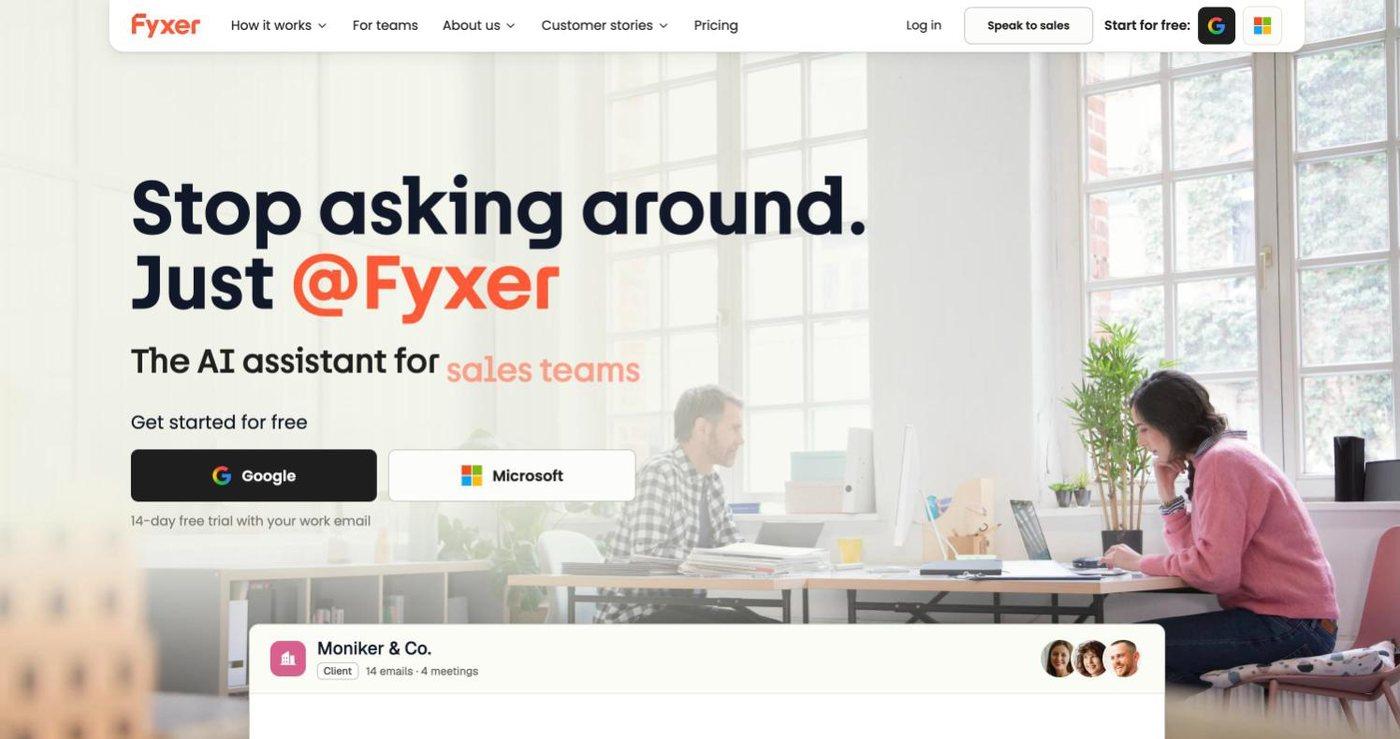
- Fyxer's homepage hero shows an office photo, with the product's chat window rising into view.
- The headline is 5 words: “Stop asking around. Just @Fyxer”.
- The two buttons are sign-ups: one with Google, one with Microsoft.
- The headline is set in F37 Hybrid, 80px.
- Fyxer's homepage scores 95 out of 100 on our homepage scorecard. Its first screen is balanced on our 5-second test (45 out of 100 on desktop, 53 on a phone).
- Measured November 2026.
Hero palette
- #F3F1EA
- #121826
- #FF5A36
The milestone
Fyxer by the numbers
Fyxer is an AI assistant for email, meetings and client work. It sorts the inbox, drafts replies in the user's voice, takes meeting notes and answers questions about clients across email, Slack and Teams.
- $1M → $17Mrun-rate revenue, from January to August 2025, according to FyxerSource: Fyxer
- 90%of users still active after three months, according to FyxerSource: Fyxer
- 25,000+companies, as stated on the homepageSource: fyxer.com
- In September 2025 Fyxer raised a $30M Series B led by Madrona, with Lakestar. Fyxer says its run-rate revenue grew from $1M at the start of 2025 to over $17M by August. Source: Fyxer
Design moves that work
5 things the Fyxer site does well
- 01
Homepage
A command as the headline
“Stop asking around. Just @Fyxer” is written the way people use the product: by mentioning it, like a colleague. The subhead names the audience, and the last words rotate between teams, such as sales teams and client-facing teams. The two buttons sign you up with the email account you already use.
- 1The problem, in three words
- 2Written the way you use it
- 3The audience rotates by team
- 4Sign up with the account you have
- 02
Homepage
The assistant answering a real question
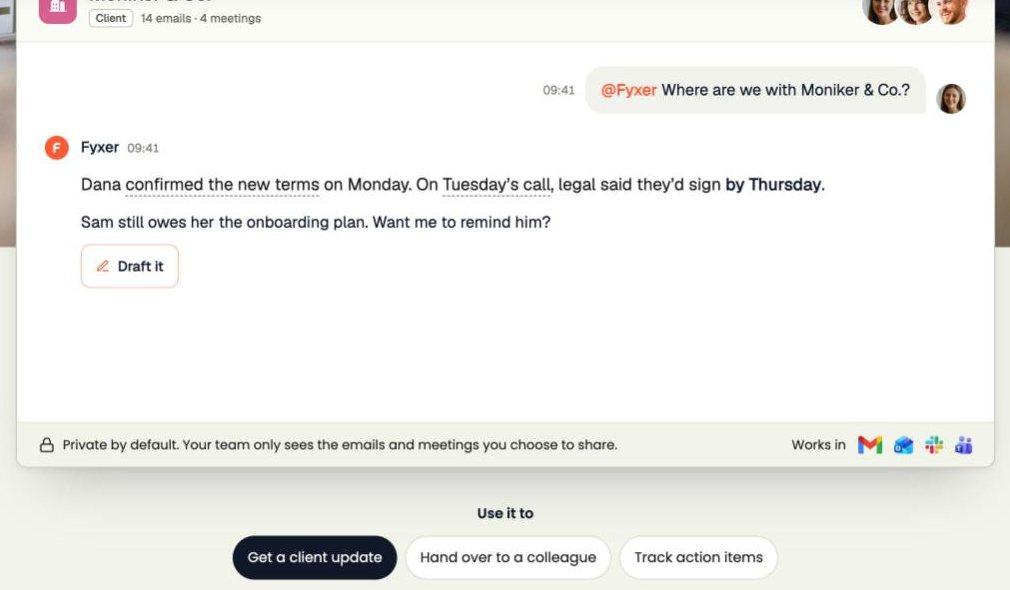
Just below the hero, someone asks “Where are we with Moniker & Co.?” and Fyxer answers with what happened on email and on a call, with the source of each fact underlined, then offers to draft the follow-up. A line under the chat says the data is private by default.
- 1Asked like a colleague
- 2Each fact shows its source
- 3One click to act on it
- 4Privacy, stated in the product
- 5Three jobs to try
- 03
Homepage
The inbox, sorted and drafted
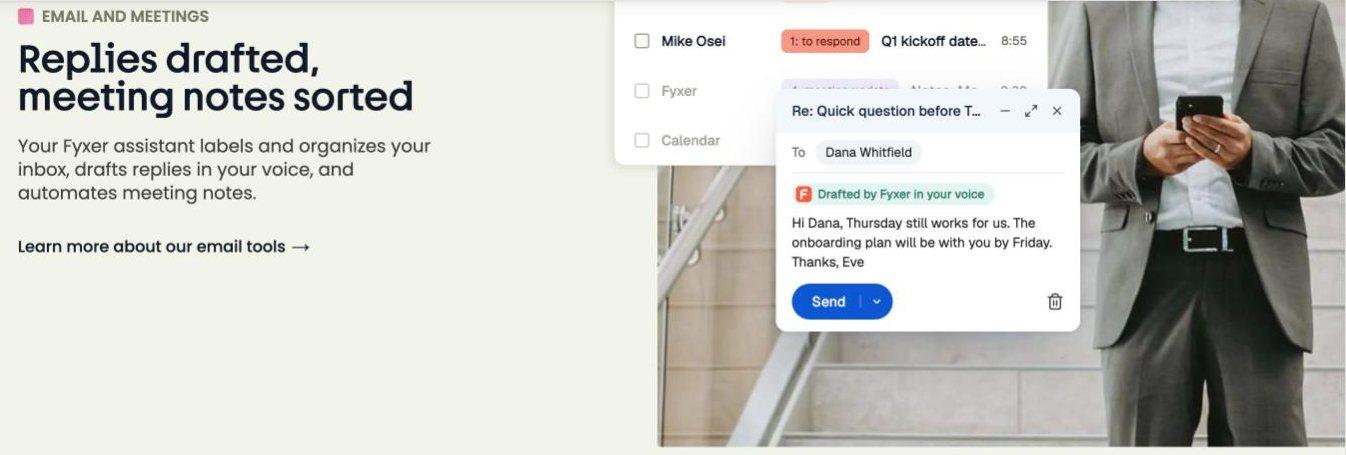
“Replies drafted, meeting notes sorted” shows the two everyday jobs: an inbox labelled by what needs you, and a reply drafted “in your voice”, ready to send.
- 1The two jobs it does
- 2Sorted by what needs you
- 3Drafted in your voice
- 4Ready to send
- 04
Homepage
Quotes about outcomes, not features
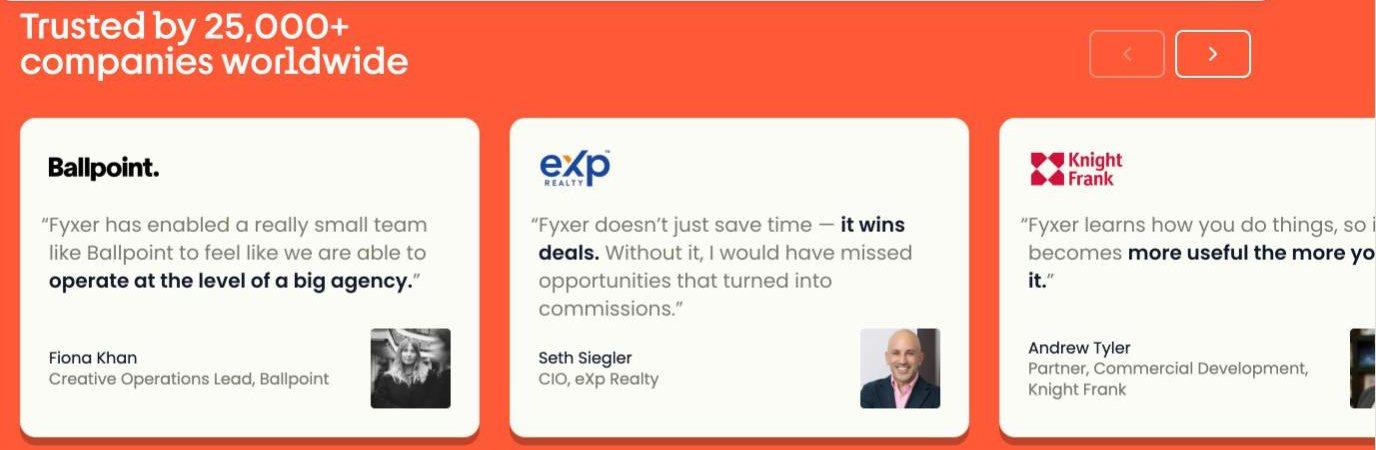
“Trusted by 25,000+ companies worldwide” leads into quotes with a logo, a name and a role, and the key phrase in bold: “operate at the level of a big agency”, “it wins deals”.
- 1A number in the heading
- 2A logo on every quote
- 3The key phrase in bold
- 4Name and role
- 05
Homepage
The founding story, as a number
“Trained on 500k hours of human EA expertise” explains why the product should be good: Fyxer started in 2016 as Fyxer People, which it describes as Europe's largest human executive assistant agency.
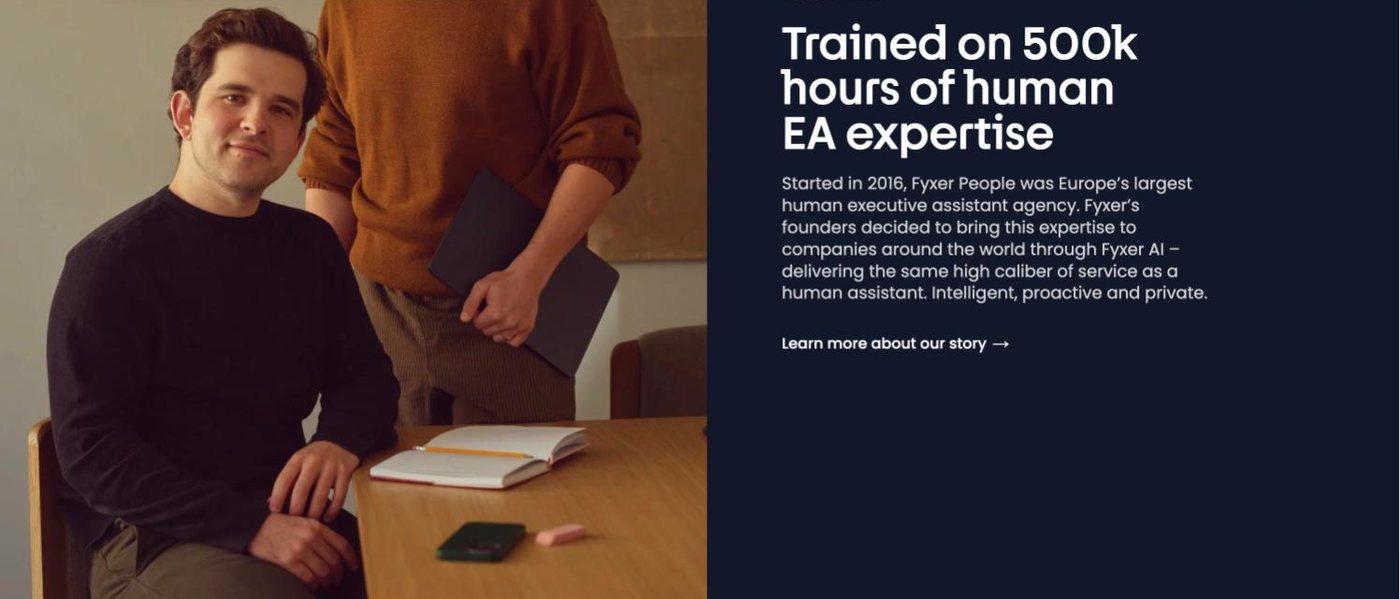
- 1A number that explains the product
- 2Where the expertise came from
- 3The founders, in person
Homepage scorecard
Fyxer scores 95 out of 100
Six checks of homepage best practice, the same ones we use on any site. Each is scored from the homepage as we captured it.
Says what it is and who it's for
20 / 20
20 if the first screen says what the product does and who it's for; 10 if one of those is left vague; 0 if neither.
Shows the product
20 / 20
20 if real product (interface, code or output) appears in the hero or the next section; 10 if it appears further down; 0 if not at all.
Proof early on
20 / 20
20 if logos, figures or named customers appear in the first two screens; 10 if further down; 0 if none.
A clear next step
15 / 15
15 for a button or input in the hero; 8 if the only call to action is in the navigation; 0 if none.
Works on a phone
15 / 15
15 if the headline and the main action both fit the phone's first screen; 8 if only the headline does; 0 if neither.
First-screen focus
5 / 10
Our 5-second test score divided by 10. It measures how visually focused the first screen is, so full-bleed photos, video and gradients score lower by design.
First-screen focus, in detail
The office photo fills the whole first screen behind the text, so there's little empty space. The large headline still reads first. We ran the first screen, at 1,362 by 868 pixels, through our free 5-second test on 24 November 2026.
Desktop, 1,362 by 868
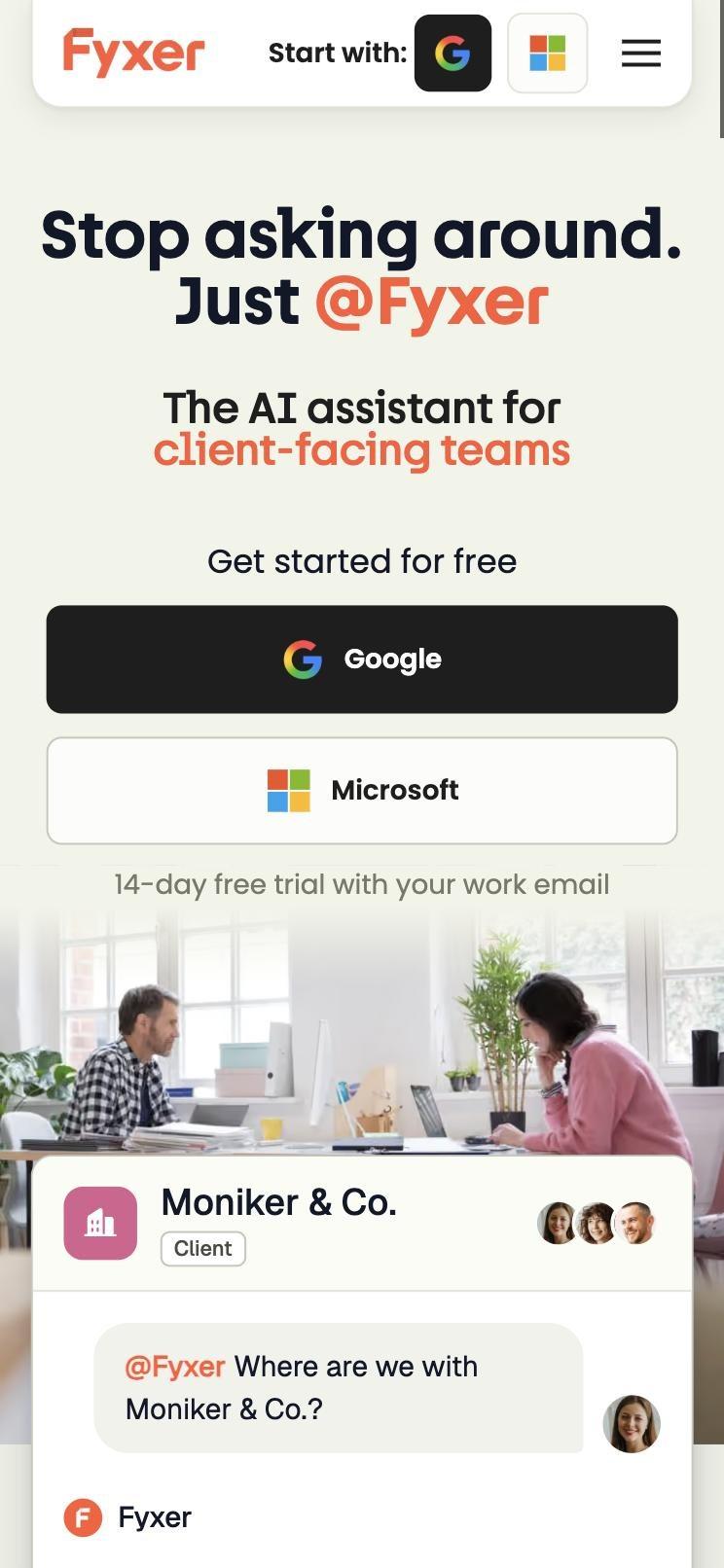
Phone, 375 by 812
53
Balanced · 8 focal points
On a phone the sign-up buttons go full width and the photo moves below them, so the headline and buttons have a plain background. The photo and chat below still compete. First screen at 375 by 812 pixels, tested on 24 November 2026.
Test your own first screenThe takeaway for founders
What to borrow, at your stage
You probably don't have Fyxer's team or budget. Here's how to take each idea with a smaller one.
- 01
Write the headline the way people use the product.
At your stage: If people trigger your product with a command, a mention or a shortcut, show that in the headline.
- 02
Let people sign up with the account they already use.
At your stage: If your product works on Google or Microsoft data, make those the buttons. It removes a step and says what it connects to.
- 03
Show the product answering a real question.
At your stage: Pick the question your buyer asks most often and show your product's answer, sources and all.
- 04
Turn your background into a number.
At your stage: Years, hours or customers from before the product launched can explain why it works.
Send us your page or deck. We'll come back with a scoped redesign and a fixed quote within 48 hours.
More teardowns
Keep looking
- Nº 25 · hyperexponentialSeries B
 Series B · $73MScorecard 87/100
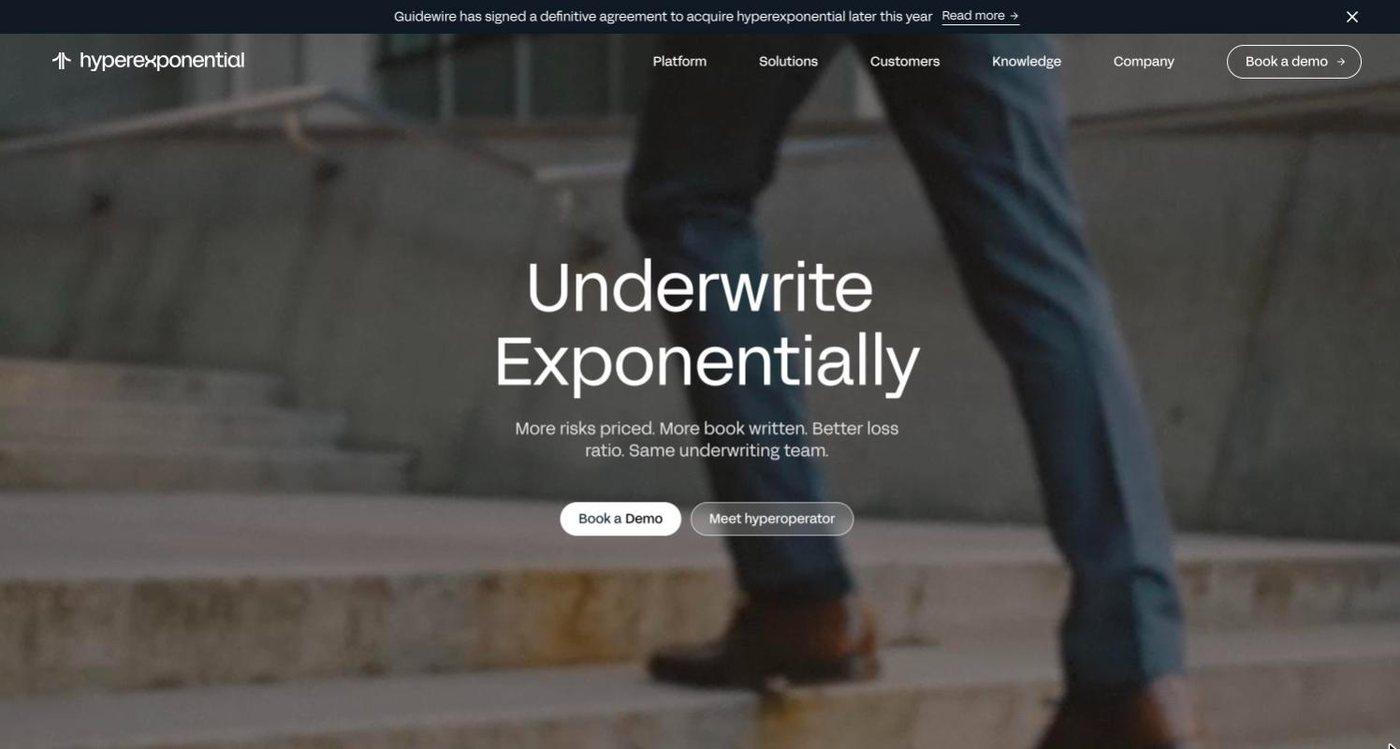
hyperexponential raised a $73M Series B. Its homepage speaks underwriting, not software.
How a London insurance pricing company sells to underwriters: a two-word promise, four outcomes in one line, carrier logos with a premium figure, and an AI agent shown answering a real request.
Read the teardown - Nº 24 · NscaleSeries B
 Series B · $1.1bnScorecard 57/100
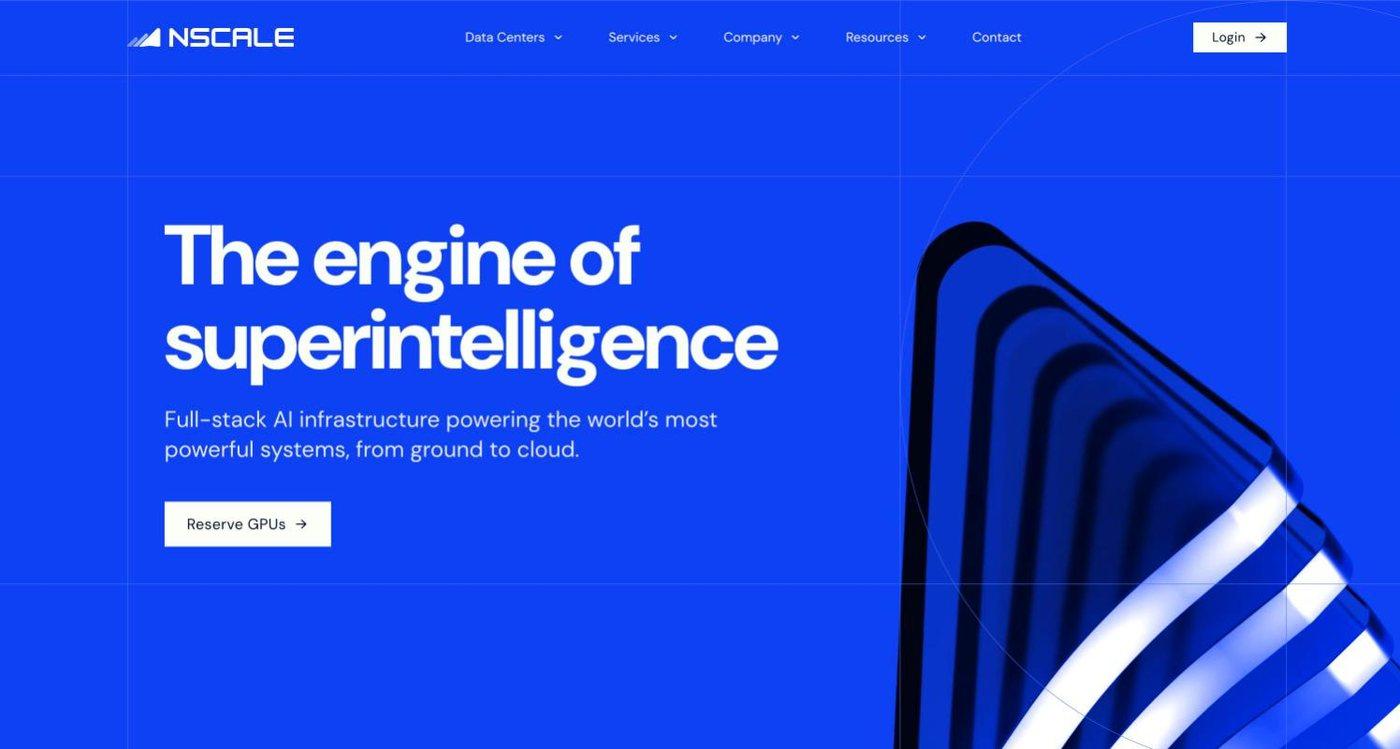
Nscale raised a $1.1bn Series B. Its homepage sells AI infrastructure with one bold line and one button.
How a UK AI infrastructure company sells to AI labs and enterprises: a five-word claim, a button that names the product, the stack drawn layer by layer, and a quote from the UK's AI minister.
Read the teardown - Nº 23 · QuantexaCategory leader
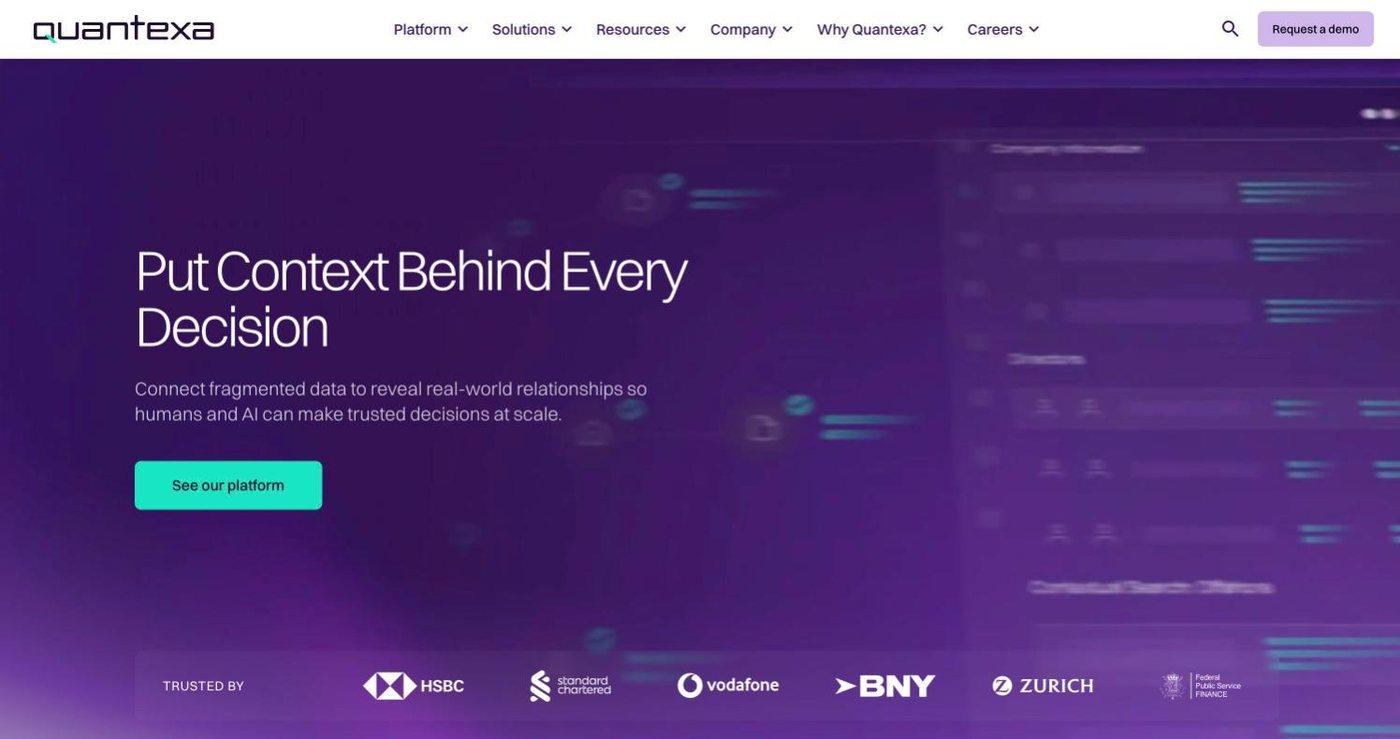 Series F · $175MScorecard 88/100
Quantexa raised a $175M Series F. Its homepage puts the bank logos in the first screen.
How London's decision intelligence company sells to banks and governments: a promise about decisions, the product blurred behind the hero, recognisable customers straight away, and three outcomes in product UI.
Read the teardown
dgitl isn't affiliated with Fyxer. Screenshots are used for commentary and belong to their owners. Figures are from the public sources linked above.