Sales decks
SaaS sales deck design.
Sales decks for B2B SaaS that follow the buyer's decision, not your feature list. Designed as a template every rep can present, and a version buyers can forward.
Four things, done properly.
- 01Sales narrative and slide order
- 02Designed deck and master template
- 03Presented and send-ahead versions
- 04Objection and pricing slides
How it works with us
- Fixed quote, agreed up frontThe price in your proposal is what you pay, unless the scope changes.
- Proposal within 48 hoursSend a brief async. No discovery call needed.
- Two review rounds per milestoneFeedback in Figma or Loom, on your schedule.
- You own the sourceEditable files, or the repo, at handover.
What it looks like.
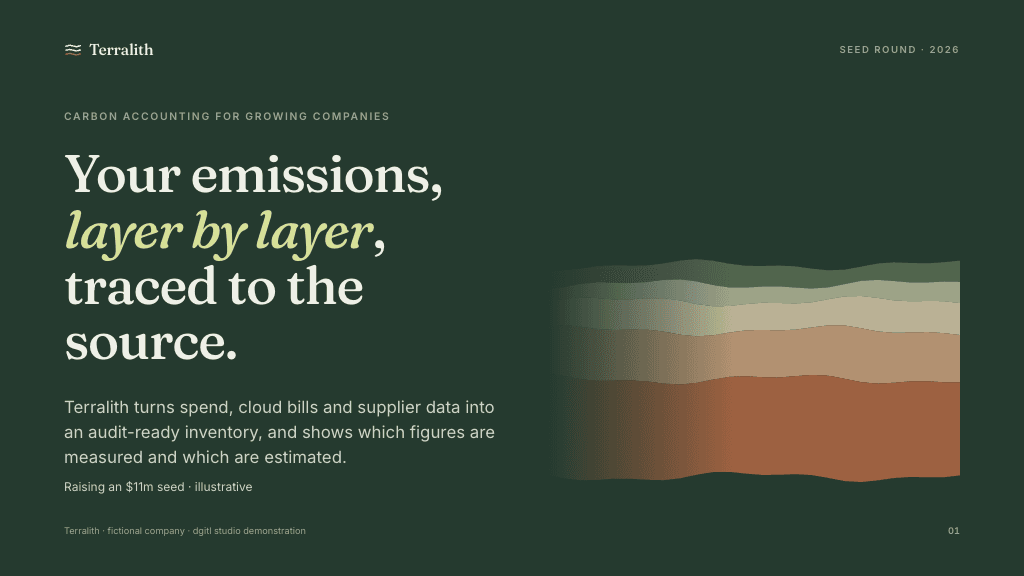
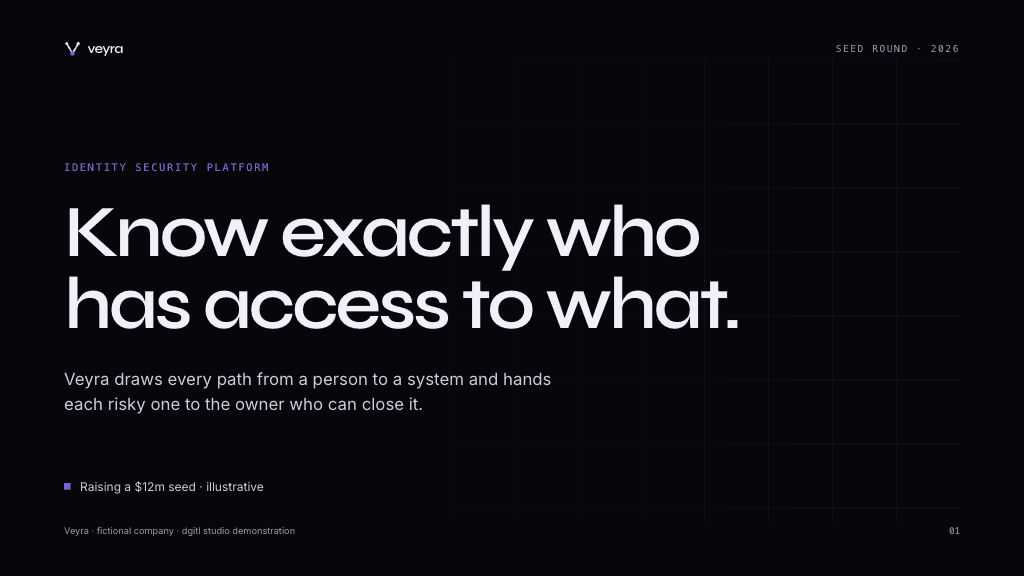
Sample brands we designed to show the work. Client work is shared on request.
What goes in a SaaS sales deck.
Most sales decks are organised around the company: who we are, what we built, every feature. Buyers are deciding whether to change how they work. This is the order we start from.
Their problem, and what it costs
Open on the situation your buyer recognises, with the cost of leaving it as it is. Your company comes later.
What changes
Why now, and what their work looks like with your product. Then a short, real walkthrough of the product doing it.
Proof from customers like them
A named result from a similar company beats a logo wall. Put it before pricing, not after.
The next step
One clear ask, such as a pilot or a technical call. Pricing, security and integrations go in an appendix you can pull in when asked.
The problem we solve.
For SaaS founders still running sales themselves, and sales leaders whose deck has grown into 40 slides nobody presents in order.
A good SaaS sales deck opens on the buyer's problem and the cost of doing nothing, shows the product changing it, then proves it with customers like them. Company history and the full feature list come later, if at all.
Typical timelines
- Sales deck redesign
- 1–2 weeks
- New sales deck from scratch
- 2–3 weeks
- Deck plus a modular slide library
- 3–4 weeks
Every project gets a fixed quote in writing before work starts. See pricing
Brief to handover in three steps.
- 1
Map the decision
We read your current deck and call notes, and agree what the buyer has to believe at each step before any design.
- 2
Design the deck
A short main deck with proof early, plus modular slides for industries, objections and pricing.
- 3
Roll it out
A master template, a send-ahead version and a short guide, so reps stay on message.
Every rep tells the same story, and buyers can forward it without you.
Before you brief this.
What should a SaaS sales deck include?
The buyer's problem and what it costs them, why now, how your product changes it, a short product walkthrough, proof from similar customers, how you compare with the alternatives, and a clear next step. Pricing and security detail usually go in an appendix.
How many slides should a sales deck have?
Usually 10 to 15 in the main deck, presented in about 20 minutes, with an appendix of modular slides for specific industries, objections and pricing.
What's the difference between a sales deck and a pitch deck?
A pitch deck persuades investors to fund the company. A sales deck persuades a buyer that your product solves their problem, so it leads with the customer's problem and proof from customers like them, not market size or the raise.
Do you make a send-ahead version?
Yes. Buyers forward decks to colleagues who never saw the presentation, so we design a version with a little more text that reads on its own.
Can you work from our existing sales deck?
Yes, that's how most projects start. We restructure the story around the buyer's decision, cut what doesn't earn its place and rebuild it as a template.
Who designs the deck?
You work directly with the principal designer who scoped the engagement. No account managers and no junior hand-offs.
Do we need live calls?
dgitl is async-first. Slack checkpoints, a written workspace, and Loom at milestones. Live conversations are reserved for blocks that cannot move forward in writing.