SaaS pitch deck examples, slide by slide.

Nine sample decks for SaaS companies from pre-seed to Series A. Each follows the same 12-slide order, so you can see how the story changes by stage and market.

Sample decks for fictional companies, designed by dgitl. Figures are illustrative.

The structure

The 12-slide order every example follows.

  1. 01The claimThe outcome you deliver, in one line. Not your category, not your logo on its own.
  2. 02The problemWho has the pain and what it costs them today, in their words.
  3. 03Why nowThe change that makes this possible or urgent now: a shift in technology, regulation or behaviour.
  4. 04The solutionWhat the product does, framed as the answer to the problem slide.
  5. 05How it worksHow fast a customer gets value: setup time, first result, first month.
  6. 06Product in useA real product view, so investors see it rather than read about it.
  7. 07TractionThe strongest proof for your stage: revenue, customers, usage, pilots or a waitlist.
  8. 08MarketWho buys, how many of them there are, and what they'd pay. Built bottom-up.
  9. 09Business modelHow you charge, and why that unit of pricing fits the value.
  10. 10Why we winThe alternatives buyers have today and why they pick you.
  11. 11What's nextWhere the product goes once the first job is done.
  12. 12The askHow much you're raising and the milestone it gets you to.

Add a team slide, usually before the ask. The samples leave it out because the companies are fictional.

The examples

Nine decks, and what to notice in each.

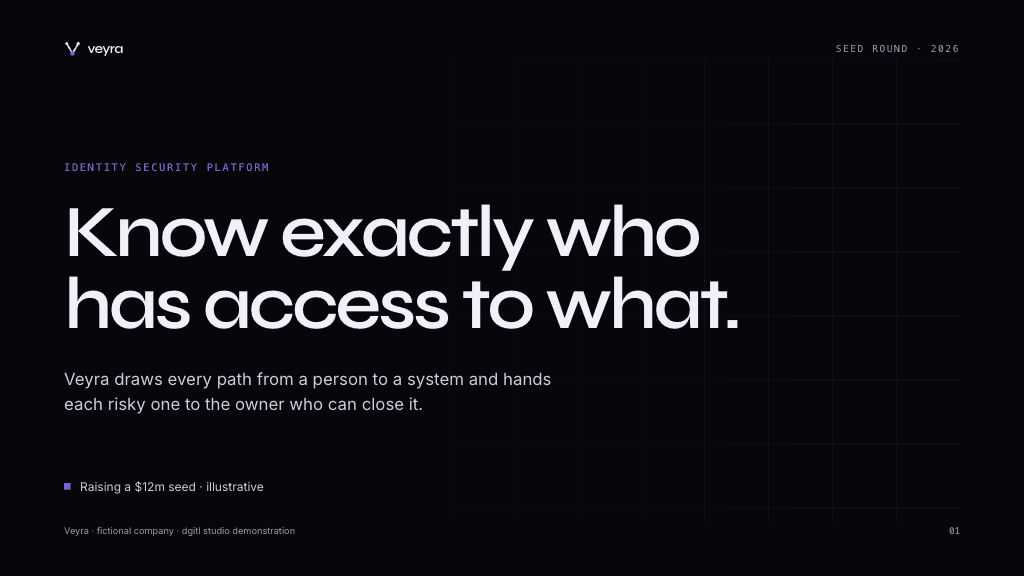
Veyra sample pitch deck cover slide

Veyra

Seed

Identity security · raising $12m seed (illustrative)

  • The cover states the outcome, not the category
  • Why-now slide uses one shift buyers already feel
  • Pricing slide explains why the model fits the risk
All 12 slide headlines
  1. 1.The claim: Know exactly who has access to what.
  2. 2.The problem: Access outlives the job, the vendor and the project.
  3. 3.Why now: Machine identities now outnumber people.
  4. 4.The solution: One risky path, one owner, one decision.
  5. 5.How it works: First graph in 14 minutes. First decision the same day.
  6. 6.Product in use: (visual slide)
  7. 7.Traction: 46 security teams, growing from one directory to the whole estate.
  8. 8.Market: Every company with a cloud bill has this problem.
  9. 9.Business model: Priced per identity, so cost follows the risk.
  10. 10.Why we win: Decisions in days, where others deliver an inventory in months.
  11. 11.What's next: From closing old access to never granting it for good.
  12. 12.The ask: $12m seed.
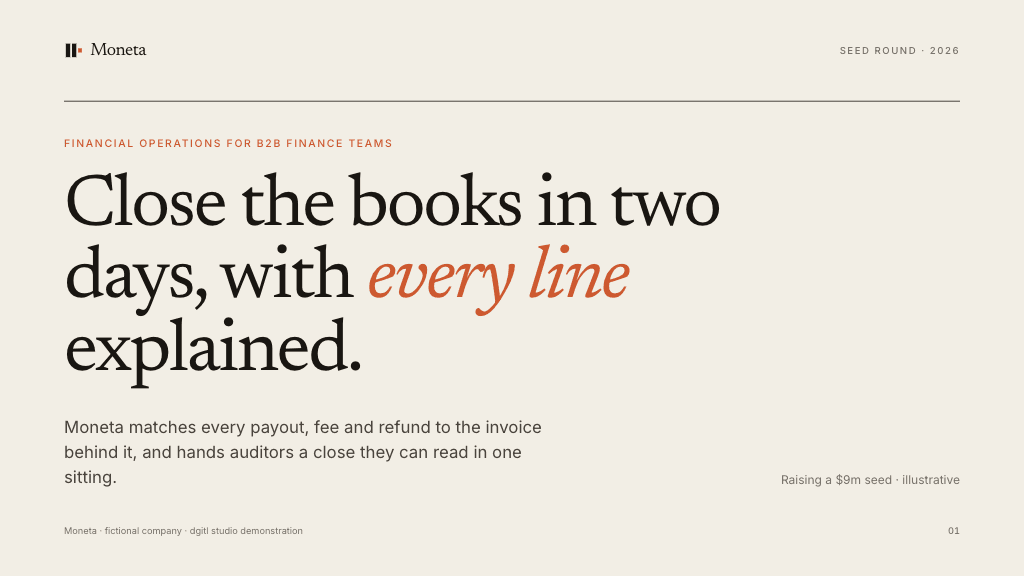
Moneta sample pitch deck cover slide

Moneta

Seed

Financial operations · raising $9m seed (illustrative)

  • A number in the very first headline
  • Onboarding slide answers “how long until it works?”
  • Traction stated as customers doing the job
All 12 slide headlines
  1. 1.The claim: Close the books in two days, with every line explained.
  2. 2.The problem: The close still lives in a spreadsheet next to the ledger.
  3. 3.Why now: More ways to get paid. The same finance team.
  4. 4.The solution: Every bank line, matched to its invoice. Every gap, explained.
  5. 5.How it works: A month of history on day one. A two-day close by month three.
  6. 6.Product in use: (visual slide)
  7. 7.Traction: 120 finance teams close their month in Moneta.
  8. 8.Market: Every company that bills another company reconciles.
  9. 9.Business model: Priced on the volume we reconcile, so cost follows the work.
  10. 10.Why we win: The match itself, with the reason attached.
  11. 11.What's next: From a faster close to a close that never stops.
  12. 12.The ask: $9m seed.
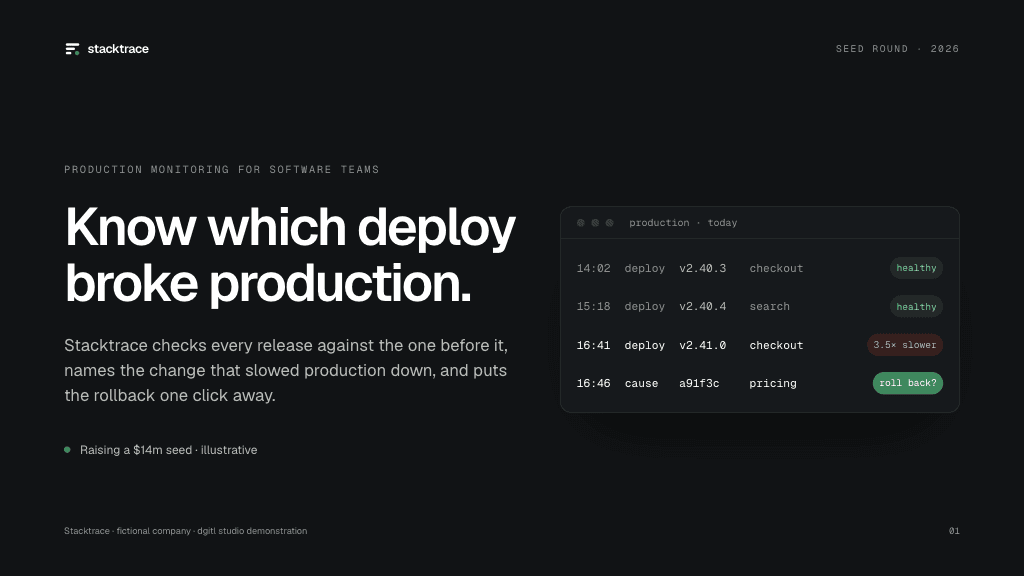
Stacktrace sample pitch deck cover slide

Stacktrace

Seed

Production monitoring · raising $14m seed (illustrative)

  • Problem slide contrasts the status quo in one line
  • Traction slide hints at the growth loop
  • Competition framed as a different starting point
All 12 slide headlines
  1. 1.The claim: Know which deploy broke production.
  2. 2.The problem: Most incidents start with a deploy. Most tools start with a dashboard.
  3. 3.Why now: Teams ship ten times a day. On-call stayed the same size.
  4. 4.The solution: One screen: what changed, what it broke, and the way back.
  5. 5.How it works: Ten minutes to set up. Five minutes to a verdict.
  6. 6.Product in use: (visual slide)
  7. 7.Traction: 300 teams, most of them found us during an incident.
  8. 8.Market: Every team that deploys is a buyer.
  9. 9.Business model: Priced by data, so every engineer gets a seat.
  10. 10.Why we win: The only tool that starts from the change.
  11. 11.What's next: From naming the bad deploy to stopping it.
  12. 12.The ask: $14m seed.
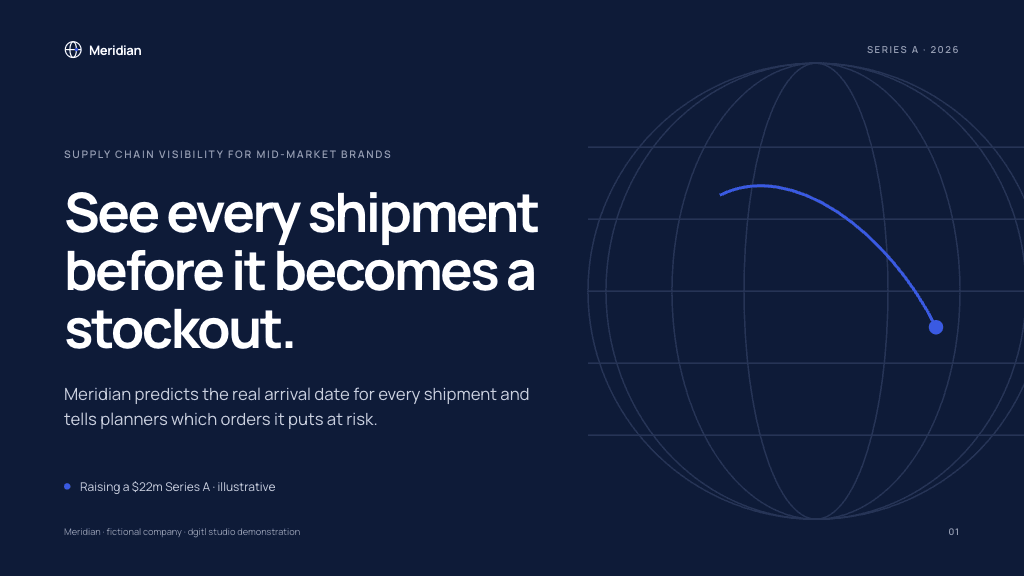
Meridian sample pitch deck cover slide

Meridian

Series A

Supply chain visibility · raising $22m Series A (illustrative)

  • The whole deck follows one shipment
  • Rollout slide shows land-and-expand in a sentence
  • Series A ask sized to the next proof point
All 12 slide headlines
  1. 1.The claim: See every shipment before it becomes a stockout.
  2. 2.The problem: A late ship is news. The orders it breaks are a surprise.
  3. 3.Why now: Routes change weekly. Planning teams didn’t grow.
  4. 4.The solution: The late shipment, the orders it breaks, and the fix.
  5. 5.How it works: One lane live in a week. The whole network in a quarter.
  6. 6.Product in use: (visual slide)
  7. 7.Traction: 85 consumer brands run their freight through Meridian.
  8. 8.Market: Every brand that imports is exposed.
  9. 9.Business model: A platform fee, plus the lanes a brand actually runs.
  10. 10.Why we win: From where the freight is to what to do about it.
  11. 11.What's next: From seeing the delay to planning around it.
  12. 12.The ask: $22m Series A.
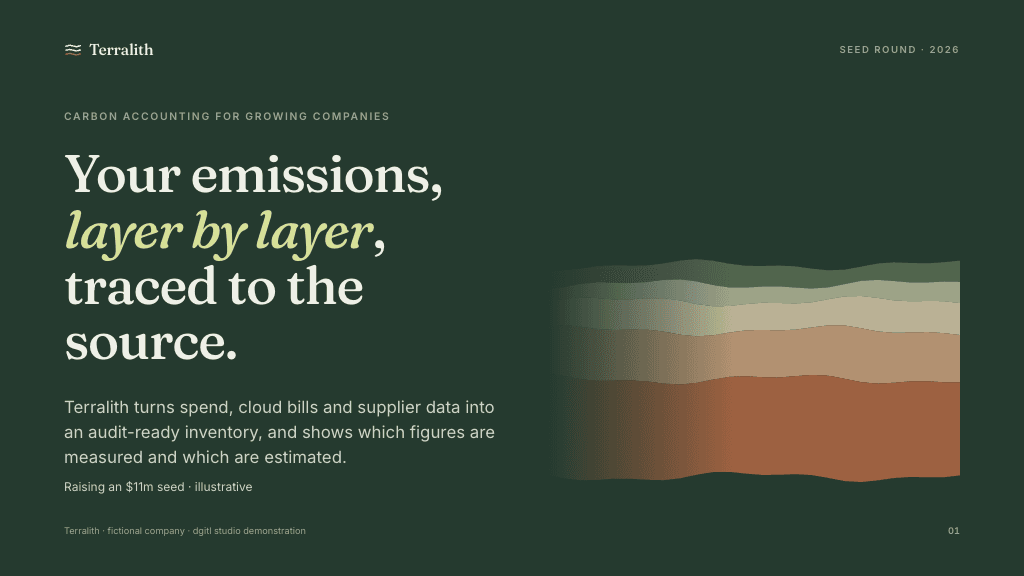
Terralith sample pitch deck cover slide

Terralith

Seed

Carbon accounting · raising $11m seed (illustrative)

  • One visual device (strata) carries the whole deck
  • Why-now ties to regulation, not hype
  • Every figure marked measured or estimated
All 12 slide headlines
  1. 1.The claim: Your emissions, layer by layer, traced to the source.
  2. 2.The problem: The carbon inventory is a yearly project. Auditors want a ledger.
  3. 3.Why now: Climate numbers moved from the brochure to the annual report.
  4. 4.The solution: The whole footprint, layer by layer, with every number traced.
  5. 5.How it works: A first inventory in three weeks. A better one every month.
  6. 6.Product in use: (visual slide)
  7. 7.Traction: (visual slide)
  8. 8.Market: Every company in a regulated supply chain needs a number.
  9. 9.Business model: A yearly platform fee, plus the sites you measure.
  10. 10.Why we win: Always current, and measured wherever the data exists.
  11. 11.What's next: From a number you can file to a plan you can fund.
  12. 12.The ask: $11m seed.
Lorzai sample pitch deck cover slide

Lorzai

Pre-seed

AI task-bot · raising £3m pre-seed (illustrative)

  • Pre-revenue traction shown as a waitlist
  • Product shown as a conversation, not a feature list
  • Trust handled head-on in the competition slide
All 12 slide headlines
  1. 1.The claim: Meet Lorzai, the task-bot designed by you.
  2. 2.The problem: The small stuff lives in nine different apps.
  3. 3.Why now: Assistants can finally act, once people trust them to.
  4. 4.The solution: Like texting someone who knows the plan.
  5. 5.How it works: Talk naturally. Lorzai structures the rest.
  6. 6.Product in use: (visual slide)
  7. 7.Traction: A waitlist that grew by word of mouth.
  8. 8.Market: Busy professionals already pay for five tools that each do a fifth of this.
  9. 9.Business model: One simple subscription.
  10. 10.Why we win: Personal enough to act, careful enough to ask.
  11. 11.What's next: From personal assistant to the household and the team.
  12. 12.The ask: £3m pre-seed.
Onyxi sample pitch deck cover slide

Onyxi

Series A

Enterprise data platform · raising $18m Series A (illustrative)

  • Problem slide in four words: “Same metric. Three answers.”
  • Written for the CFO who signs off
  • Pricing tied to the unit of value
All 12 slide headlines
  1. 1.The claim: The architecture of absolute clarity.
  2. 2.The problem: Same metric. Three answers.
  3. 3.Why now: Sources multiply faster than the people who check them.
  4. 4.The solution: Every number arrives with its proof attached.
  5. 5.How it works: Every source mapped. Every transformation visible.
  6. 6.Product in use: (visual slide)
  7. 7.Traction: (visual slide)
  8. 8.Market: Every regulated company reports numbers it has to defend.
  9. 9.Business model: A platform fee, plus a price per certified source.
  10. 10.Why we win: The only layer that certifies, traces and assigns an owner.
  11. 11.What's next: From certified metrics to certified decisions.
  12. 12.The ask: $18m Series A.
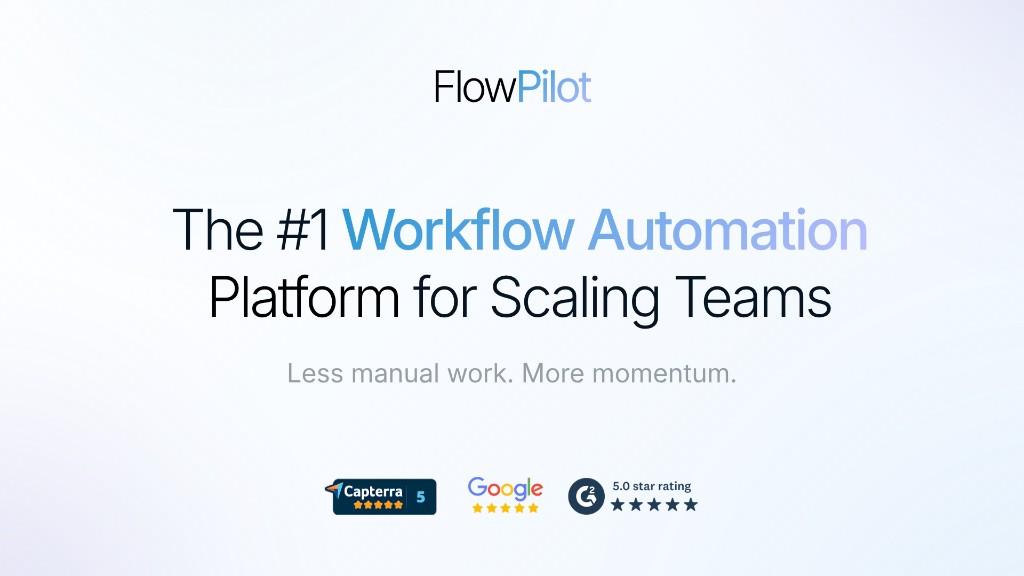
FlowPilot sample pitch deck cover slide

FlowPilot

Series A

Workflow automation · raising $16m Series A (illustrative)

  • Deck mirrors the homepage: pain, demo, proof
  • Market sized by company headcount band
  • Traction shown as usage, not just revenue
All 12 slide headlines
  1. 1.The claim: Workflow automation for scaling teams.
  2. 2.The problem: Work stalls in the handoffs, not the tasks.
  3. 3.Why now: Operations teams own more process and have fewer engineers to automate it.
  4. 4.The solution: A canvas the whole team can read.
  5. 5.How it works: Start from a template. Tune it in an afternoon.
  6. 6.Product in use: (visual slide)
  7. 7.Traction: Automations launched each month.
  8. 8.Market: Every company between 200 and 2,000 people runs on handoffs.
  9. 9.Business model: Priced by active workflow, so cost follows value.
  10. 10.Why we win: Built for the people who own the process.
  11. 11.What's next: From automating handoffs to predicting them.
  12. 12.The ask: $16m Series A.
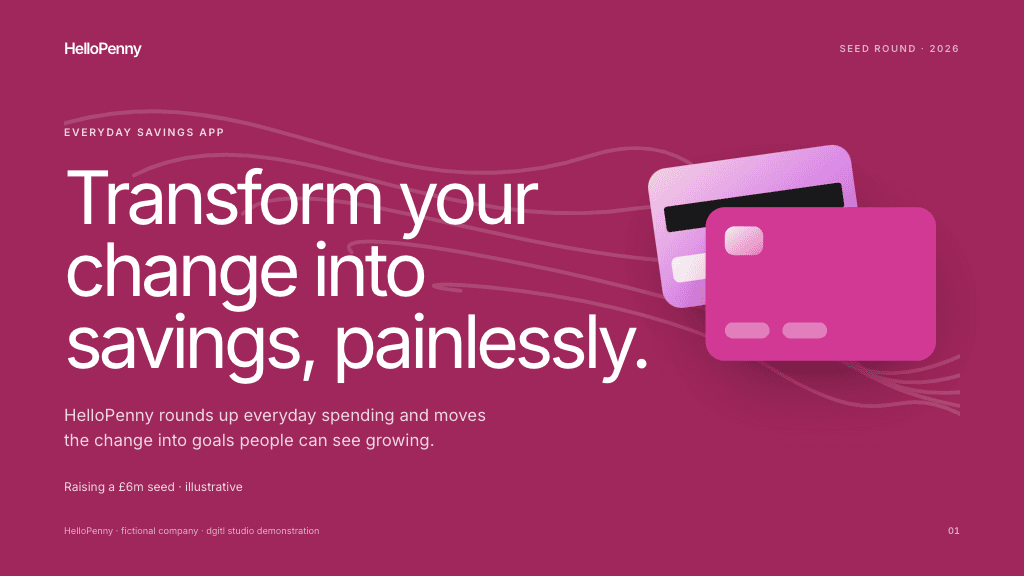
HelloPenny sample pitch deck cover slide

HelloPenny

Seed

Savings app · raising £6m seed (illustrative)

  • A consumer deck built around a habit loop
  • Retention and referral as the traction story
  • Competition framed by tone, not features
All 12 slide headlines
  1. 1.The claim: Transform your change into savings, painlessly.
  2. 2.The problem: Saving feels like a chore, so most people stop.
  3. 3.Why now: Open banking makes roundups work from any card.
  4. 4.The solution: Every penny has somewhere to go.
  5. 5.How it works: Three small moves, every single day.
  6. 6.Product in use: (visual slide)
  7. 7.Traction: Members who stay, and tell their friends.
  8. 8.Market: Starting with the UK, where saving is a habit people want back.
  9. 9.Business model: Free to start. Plus when people want more.
  10. 10.Why we win: The friendly one in a category built on guilt.
  11. 11.What's next: From spare change to a whole savings habit.
  12. 12.The ask: £6m seed.
Using examples well

Copy the structure, not the slides.

Read each deck's headlines in order, without the visuals. If the headlines alone tell the story, the deck works. That's the test to run on your own deck before you touch the design.

Then look at how the same slide changes by stage. The pre-seed deck proves demand with a waitlist; the Series A decks prove it with customers and usage. Use the evidence you actually have.

FAQ

Pitch deck example questions.

What should a SaaS pitch deck include?

Most SaaS decks cover the claim, the problem, why now, the solution, how it works, the product, traction, market, business model, competition, what's next and the ask, plus a team slide. The samples on this page follow that order in 12 slides.

How many slides should a SaaS pitch deck have?

Around 10 to 15 main slides, with detail in an appendix. Every sample here uses 12, which is enough to make the case without asking an investor to read a document.

Are these real pitch decks?

No. They're sample decks for fictional companies, designed by dgitl to show structure and design. The figures are illustrative. For decks that real companies used to raise, collections such as AngelBacked and Best Pitch Deck share examples like Buffer's and Intercom's early decks.

Can I use these as a template?

Use the slide order and the headline style freely: it's the most useful part. The visual designs are our own work, so build your deck in your own brand. Our free pitch deck checker will tell you which core slides your deck is missing.

Why don't the samples have a team slide?

Because the companies are fictional. A real deck should include one: early-stage investors back people, so say who you are and why you're the team to win this.

Want a deck like these for your raise?

Send your current deck or notes. You'll get a scope, timeline and fixed quote within 48 hours.